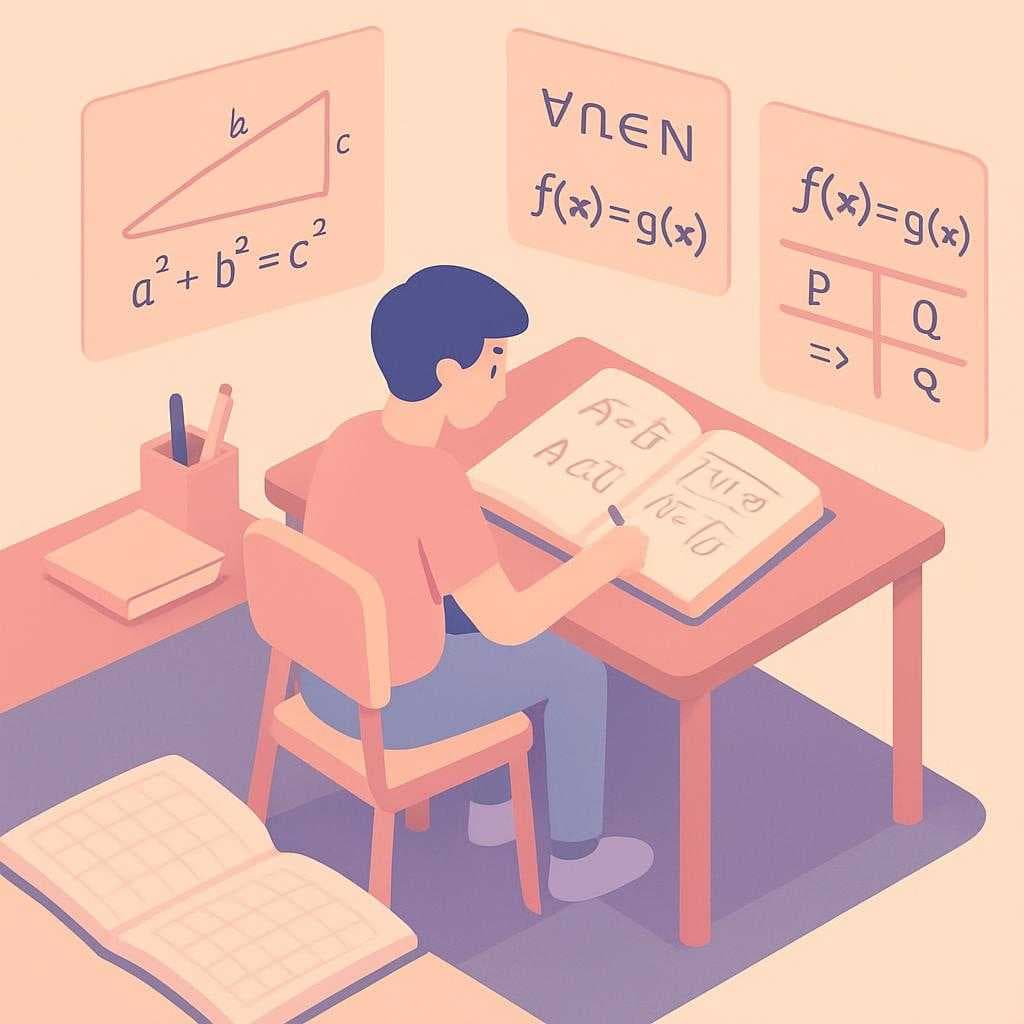
Mastering the Art of Proof: A Guide for GCSE Further Mathematics Students
Unlock the Secrets of Effective Proof Techniques with AQA, Edexcel, and OCR
Studying GCSE Further Mathematics in the UK can be a challenging yet rewarding experience. With the right focus and strategies, students can excel, especially in areas that demand rigorous logical reasoning, such as mathematical proof. In this article, we'll delve into mastering proof techniques, a crucial element of the curriculum across major exam boards like AQA, Edexcel, and OCR.
Understanding the Importance of Proof
Mathematical proof is the cornerstone of advanced mathematics, serving as the method by which students can demonstrate the validity of mathematical statements. This skill is essential, not only for examinations but also for developing a deeper understanding of mathematical concepts. Whether you're tackling AQA's rigorous problem-solving tasks, Edexcel's analytical challenges, or OCR's structured questions, mastering proof techniques will give you a competitive edge.
Key Proof Techniques to Master
-
Direct Proof: This is the most straightforward method, involving a logical sequence of statements that lead directly from the hypothesis to the conclusion. For example, proving that the sum of two even numbers is even involves showing that their sum can be expressed as 2 times an integer.
-
Contradiction: A powerful technique where you assume the opposite of what you want to prove, then show that this assumption leads to a contradiction. This method is often used in situations where direct proof is challenging.
-
Contrapositive: Similar to proof by contradiction, this method involves proving that the contrapositive of a statement is true, thereby proving the original statement. This can be particularly useful in conditional statements.
-
Induction: This technique is vital for proving statements about integers. It involves showing that if a statement is true for one integer, it is true for the next, and thereby true for all integers.
Tailoring Strategies for Exam Boards
-
AQA: Focus on understanding how proofs can be applied to real-world problems. AQA often incorporates practical applications into their questions, so practice applying proofs to diverse scenarios.
-
Edexcel: Emphasize clarity and precision in your logical reasoning. Edexcel exams often require detailed explanations, so practice articulating each step of your proof clearly.
-
OCR: Pay attention to the structure and format of your proofs. OCR values well-organized solutions, so practice writing proofs that are not only correct but also neatly presented.
Conclusion
By mastering these proof techniques, you can tackle any problem that comes your way in GCSE Further Mathematics. Remember, practice is key. Work through past papers from AQA, Edexcel, and OCR to familiarize yourself with the types of questions you might encounter. With dedication and the right strategies, you'll find yourself excelling in this challenging yet rewarding subject.